In March 2025, Georgetown's Historic and Architectural Review Commission looked at a rendering for a decades-old building at 817 S. Austin Ave, a block off the Williamson County Courthouse square, and said no. The owner, Adam Starr, wanted to strip back a later addition and expose the building's original double gable roof and its historic wood trusses. HARC denied the Certificate of Appropriateness, citing the plan's break from the block's uniform storefront look. Three months later the case landed in front of City Council on appeal, and the commission's decision didn't survive contact with an elected body. Council voted 6-1 to approve the appeal, with Mayor Pro Tem Kevin Pitts arguing it was impossible for any applicant to satisfy every guideline and that meeting 34 of the district's 37 design standards should be enough to move forward.
Newly elected council member Ben Butler cast the lone no vote.
"I do like what you did, it's just in the wrong spot."
Whatever you think of that roofline, the case is a useful window into how Georgetown's historic districts actually work, and it points at something buyers, sellers, and renovators in Old Town and Downtown Georgetown consistently get wrong. They assume the size of a project, or the size of the check behind it, determines how much scrutiny it gets. It doesn't. Two other things decide that, and neither has anything to do with your budget.
The test is what shows, not what it costs
According to J. Bryant Boyd, an architecture and design-build firm that has worked across Central Texas since 1992, the review requirement inside Georgetown's Downtown and Old Town Historic Overlay Districts turns on whether a project changes the visible exterior character of a property, not on its scope or cost. A rear addition built purely to gain square footage can still require sign-off if any part of it reads from the street. Replacing original windows or siding can trigger the same review if those elements carry the home's historic character. Even a new fence, one of the cheaper line items on any renovation budget, can require review because of how it changes the way the property reads from the sidewalk.
That inversion catches people mid-project. One of the more common mistakes homeowners make, per that same guide, is assuming the review conversation happens after the design is finished, when it needs to happen before a single drawing is locked in.
Your specific address carries its own label
Layered on top of the visibility test is a second variable that has nothing to do with the project at all: the historic priority level attached to your specific parcel. The City of Georgetown labels every contributing structure inside the two overlay districts as Low, Medium, or High priority, based on the building's historic or architectural significance, and that label is what determines whether a given scope of work needs no review at all, a staff-level sign-off from the Historic Preservation Officer, or a full public hearing in front of the Commission. The city's Certificate of Appropriateness Applicability Table, written into Section 3.13 of the Unified Development Code, cross-references the type of work against the priority level to land on one of three outcomes: no review, administrative approval, or a commission hearing.
The practical result is that two homes on the same Old Town block, undergoing an identical scope of exterior work, can land in completely different review tracks if one carries a higher priority designation than the other. Buyers who want to renovate visibly after closing have a way to check this before they write an offer. The city's Interactive Historic Properties map shows the priority level attached to any specific address inside the overlay districts, and it is worth pulling up before falling for a fixer-upper on the square.
What a commission-level review actually looks like
Most cases never reach the drama of 817 S. Austin Ave. HARC's regular agenda runs through far more ordinary requests. A February 2026 meeting took up a request at 403 S. Myrtle Street for an addition creating a new street-facing facade, with plans showing a 3-foot-9-inch encroachment into the required side setback and a 17-foot-11-inch encroachment into the required front setback. Another case, an infill construction project at 1002 S. Elm, moved through the same process on a quarter-acre lot carved out of the old Glasscock Addition platted decades ago. Neither is a landmark building under public pressure. Both are homeowners working through the same setback math and street-facing-facade questions that come up on nearly every visible renovation inside the district.
The Commission runs on a fixed clock regardless of who is applying. HARC meets the second and fourth Thursday of every month at 6 p.m., and any case that requires a public hearing has to wait for one of those two dates, with public notice built into the timeline. Anyone finishing visible renovation before listing a home, or closing a purchase contingent on planned exterior work, needs to build that twice-a-month rhythm into the schedule rather than assuming a contractor's calendar is the only one running.
Why sellers keep the paperwork
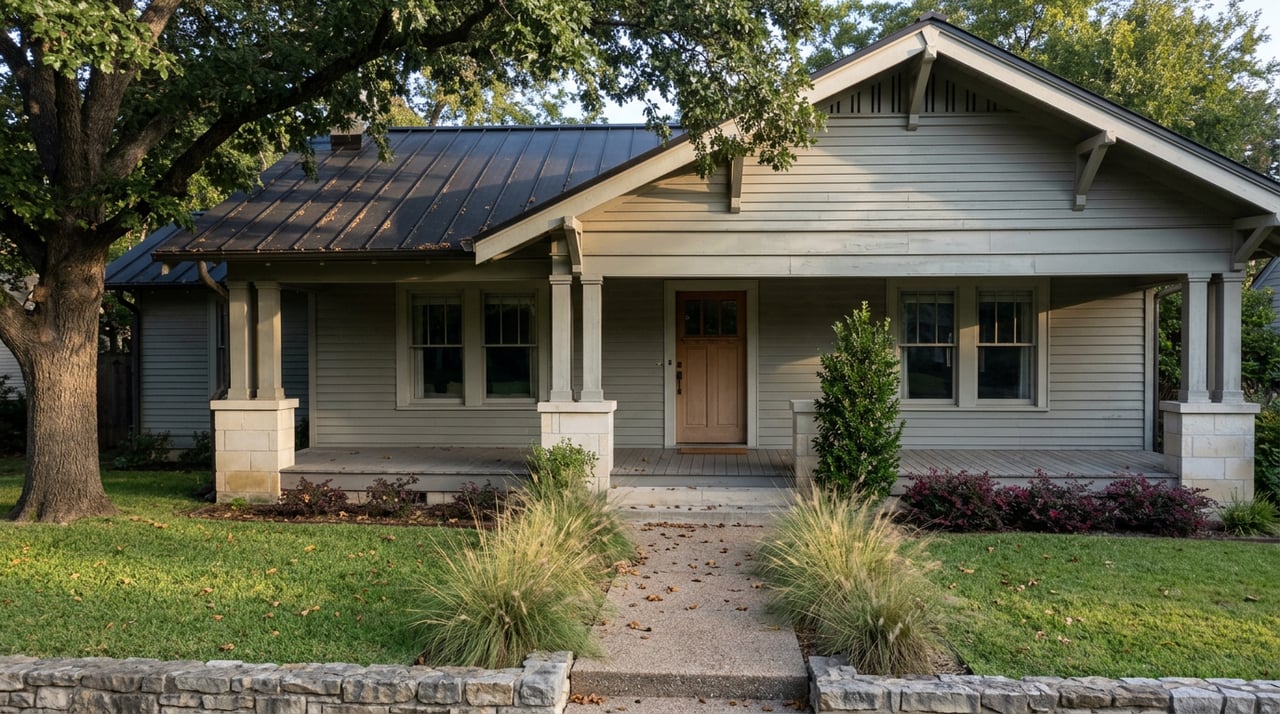
A completed, city-approved renovation becomes part of a listing's story in Old Town Georgetown, not just a checkbox. One Old Town Craftsman built in 1946 markets its 2012 renovation by naming the architect behind it, noting the work was completed under J. Bryant Boyd in coordination with Preservation Georgetown. That detail is not incidental marketing copy. It signals to a buyer that whatever review this specific renovation required, whether staff sign-off or a full Commission hearing, has already been cleared, with a paper trail to prove it.
For a seller planning visible work before a listing goes live, or a buyer evaluating a home that already went through a renovation, that approval history is worth asking for directly. A Certificate of Appropriateness is a separate step from a building permit, and the city will not issue a building or sign permit until the COA is approved. Both documents on file together are evidence the work cleared the process rather than skipping it.
Before you write an offer or finalize a design
- Pull the address on the city's Interactive Historic Properties map before buying, and check whether the structure carries a Low, Medium, or High priority label.
- If you're planning visible exterior work, cross-reference your scope against the COA Applicability Table in Section 3.13 of the Unified Development Code rather than assuming a small project skips review.
- Schedule a pre-application meeting with the city's Historic Planning staff before the design is finished, not after, especially for additions, new infill construction, or larger remodels.
- If buying a home with a completed renovation, ask for both the Certificate of Appropriateness and the building permit. The city won't issue one without the other, so having both on file is a good sign the work was done by the book.
- Build HARC's twice-monthly hearing calendar into any timeline that depends on visible work finishing before a sale closes or a listing goes live.
FAQ
Does a bigger renovation always mean a bigger review? Not in Georgetown's historic overlay districts. The determining factor is whether a project changes what's visible from the street, not its size or cost. A new fence can require the same kind of review as a much larger project, while an addition built entirely at the back of a lot can move through with no review at all if none of it can be seen from the public street.
Can I find out whether my future renovation will need a hearing before I buy? Yes. The priority level assigned to a specific address, Low, Medium, or High, is public information on the city's Interactive Historic Properties map, and it's one half of the equation that determines whether a project needs no review, staff-level approval, or a full Commission hearing.
What happens if I start visible work without a Certificate of Appropriateness? The city will not issue a building or sign permit for qualifying work inside a historic overlay district without an approved COA first. The certificate has to come before the permit, not after.
Georgetown's historic core rewards homework as much as taste. If you're weighing a fixer-upper near the square, or getting ready to list one, Ealy & Company can help you read the priority map, the hearing calendar, and the paperwork before any of it is locked in. Inspire your next chapter. Schedule a consultation with our team today.