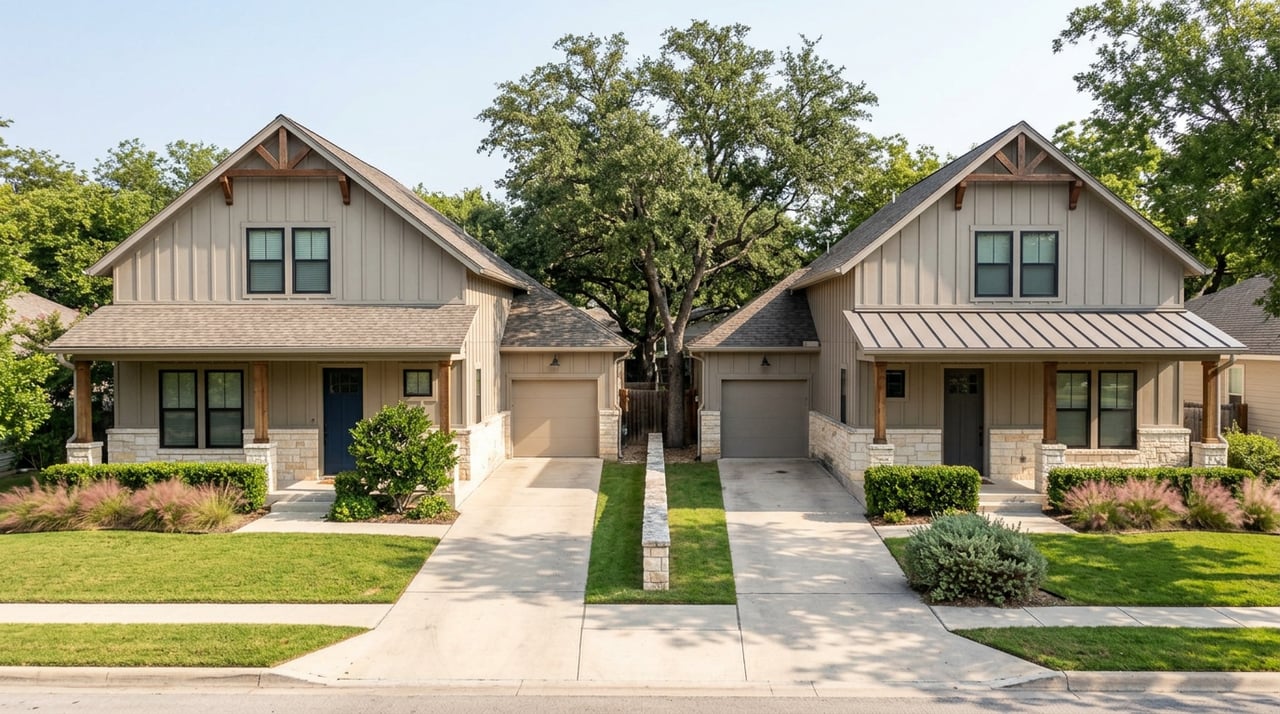
Two houses in Mayfield Ranch can sit close enough that you could walk from one driveway to the other in under a minute, share the same builder, the same lot size, the same finish level, and still be zoned to different school districts. One goes to Round Rock ISD. The other goes to Leander ISD. Nothing about the exterior tells you which is which. The only way to know is to check the address, because the boundary that decides it runs through the subdivision itself, not around it.
That single fact is the reason a citywide median price for Round Rock tells you almost nothing useful if you're actually comparing two properties. Round Rock isn't one housing market wearing one name. It's at least four school district territories stitched into a single city limit, and the seams between them run directly through some of its most recognizable neighborhoods.
One City, Four School Districts
Most of Round Rock falls under Round Rock ISD, an A-rated district with deep roots and a long list of Blue Ribbon campuses. But the city's edges reach into three other districts entirely. The northwest corner, including sections of Mayfield Ranch and Walsh Ranch, zones to Leander ISD. Parts of the southeast edge fall under Pflugerville ISD. And Teravista, one of the larger master-planned communities on the north side, straddles the line between Round Rock ISD and Georgetown ISD depending on which section of the neighborhood you're standing in.
This is why the median price you see on any national home-value tracker moves depending on which one you check. Redfin's three-month window ending June 2026 put the median sale price at $373,000. Zillow's index landed closer to $398,000 to $412,000 over roughly the same stretch. Movoto's July 2026 figure came in at $446,495. None of these are wrong exactly. They're just averaging across four different school-district markets that happen to share a city name, and the mix of what sold in a given month shifts the blended number around.
A buyer who anchors on any single one of those figures and then goes house hunting is going to be confused the first time two homes at the same price point feel like they're competing in different leagues. They are. They're just not labeled that way on the listing sheet.
Where the Line Actually Runs
The straddling isn't evenly distributed. It clusters in a handful of specific places, and knowing where matters more than knowing the citywide average ever will.
- Mayfield Ranch and Walsh Ranch, on Round Rock's northwest edge, split between Round Rock ISD and Leander ISD depending on street.
- Teravista, one of the city's largest communities, has sections zoned to Round Rock ISD and sections zoned to Georgetown ISD.
- The southeast fringe of the city, near the Pflugerville line, has pockets where Pflugerville ISD reaches into what residents would otherwise call Round Rock.
None of this shows up on a map you'd casually glance at. It shows up when you pull up an address on the district's own boundary tool and realize the house three doors down feeds a different elementary school than the one you're touring.
What the Boundary Is Worth in Dollars
The price gap tied to that boundary is real and it's not small. Looking at zone-specific data from earlier in 2026, homes in Round Rock ISD attendance areas were running roughly $385,000 to $440,000, while comparable homes inside Leander ISD zones, spanning established Cedar Park neighborhoods and newer Leander subdivisions, were running closer to $430,000 to $510,000 for similar square footage. Apply that pattern to a subdivision like Mayfield Ranch, where the two districts actually meet, and the logic holds at the parcel level: the Round Rock ISD side prices like the rest of that district's zone data, and the Leander ISD side prices like the rest of its zone data.
Zoom out to the full district level and the spread gets even more pronounced. A trailing 12-month look at single-family closed sales across each district as a whole, refreshed in late June 2026, showed a median sold price of $519,000 for homes zoned to Round Rock ISD against $625,000 for homes zoned to Leander ISD. That figure includes areas well beyond Round Rock's city limits, since both districts extend into Cedar Park and other communities, so it's a district-wide comparison rather than a same-city one. But it tells you the direction and rough scale of the pull. Real estate professionals who regularly work these boundary neighborhoods describe the same-street premium, house for house, as landing anywhere from $30,000 to $80,000 depending on the specific block.
| Comparison | Approximate figure | What it actually measures |
|---|---|---|
| Round Rock ISD zone price band | $385,000–$440,000 | Zone-specific homes, early 2026 |
| Leander ISD zone price band | $430,000–$510,000 | Zone-specific homes, early 2026 |
| Round Rock ISD, trailing 12-month median | $519,000 | District-wide, includes areas outside Round Rock city limits |
| Leander ISD, trailing 12-month median | $625,000 | District-wide, includes Cedar Park and other communities |
Read the table as evidence of a pattern, not as a precise quote for any single address. The only number that matters for a specific house is the one your agent pulls from actual closed comps on that street, zoned to that campus.
The Line Has Moved Before
Here's the part that catches people off guard even after they've done their homework on which district a house currently sits in: the line itself isn't permanent. Round Rock ISD has redrawn its attendance boundaries more than once as the district has grown, and each time, it moved entire named neighborhoods from one school to another.
In February 2020, reports by KVUE and Community Impact covered the district's approval of changes affecting six elementary schools and one middle school. Roughly 300 students in the Caraway Elementary zone were rezoned to Jollyville Elementary. About 220 students moved from Elsa England Elementary to Great Oaks Elementary, which meant families in Highland Horizon, previously the only neighborhood at England feeding Round Rock High School instead of McNeil, were folded into the more common feeder pattern. Chandler Creek, inside Teravista, had roughly 115 students shifted from Teravista Elementary to Double File Trail Elementary. And close to 470 additional students, from families living in Paloma Lake, Ryan's Crossing, Saddlebrook, Saddlebrook Estates, Settlers Overlook, and Vizcaya, were slated to move to a new elementary campus starting the following school year. The same round of changes also reached into middle and high school feeder patterns: students in the Berkman Elementary attendance area, who had previously split between Stony Point High School and Cedar Ridge High School depending on which side of C.D. Fulkes Middle School's old boundary they fell on, were consolidated onto a single Cedar Ridge feeder pattern.
A district spokesperson explained the reasoning to KVUE at the time:
"So, what really prompted this whole boundary review is because we need to draw a zone for that new school."
That wasn't even the first time. The board had approved a separate round of boundary changes back in February 2012 specifically to relieve overcrowding at the high school level. Two rounds in roughly a decade, both driven by the same underlying pressure, growth outpacing existing campus capacity.
Round Rock hasn't stopped growing since. The semiconductor investment underway in nearby Taylor has pulled a wave of suppliers and contractors into the broader corridor, with many of those workers landing in Round Rock housing. That kind of sustained demand is exactly the condition that has triggered attendance boundary reviews before. It doesn't mean a specific neighborhood is about to be rezoned. It does mean that anyone buying near an existing district line should treat the current boundary as a snapshot, not a guarantee.
Reading a Listing Like Someone Who Knows the Boundary
If you're comparing homes across Round Rock right now, the practical shift is small but it changes what you ask first.
Stop asking what the median home price in Round Rock is. Start asking which school district and which specific campus a given address feeds, verified directly against the district's boundary tool rather than assumed from the neighborhood's name. Mayfield Ranch tells you almost nothing on its own. The parcel number does.
If the address sits inside one of the known straddling zones, ask how close the current attendance line runs to that specific lot and whether the district has any pending capacity discussions for nearby campuses. A house squarely in the middle of a Leander ISD section carries less boundary risk than one three streets from where the line currently sits.
And when you're comparing sale prices between two neighborhoods, ask for zone-specific closed comps, not citywide averages pulled from a portal. The $70,000-plus spread between what different national trackers reported for Round Rock in mid-2026 is a symptom of exactly the problem this piece describes. Averaging four different school-district markets into one number produces a figure that's technically accurate and practically useless for comparing two actual houses.
FAQ
Does every Round Rock neighborhood offer a choice between school districts? No. The overlap is limited to a small number of edge communities, primarily sections of Mayfield Ranch, Walsh Ranch, and Teravista, plus scattered addresses near the Pflugerville boundary. Most of the city sits squarely within a single district.
How do I confirm which district and campus actually serves a specific address? Check directly with Round Rock ISD's own boundary and school-assignment tool rather than relying on a neighborhood's general reputation. Boundaries can run through a subdivision rather than around it, so the address matters more than the community name.
If I buy in one of the straddling neighborhoods, could my assigned school change later? It's possible. Round Rock ISD has redrawn attendance boundaries at least twice over the past decade and a half, in 2012 and again in 2020, both times to manage growth and new campus openings. Continued development pressure in the broader corridor means future reviews aren't out of the question, though none is currently scheduled for any specific neighborhood.
If you're weighing two Round Rock neighborhoods and the median price on a portal isn't giving you a straight answer, that's usually because the number is blending markets that don't actually behave the same way. Ealy & Company works these boundary lines street by street across Round Rock and the surrounding suburbs. Inspire your next chapter. Schedule a consultation.